Publications 2

Papers, preprints, and research outputs.

Markers of the Ageing Macrophage: A Systematic Review and Meta-Analysis

My 4th year integrated Masters project at the University of Sheffield was extended into a systematic meta-narrative literature review of age-related changes in macrophages which was published in Frontiers in Immunology.

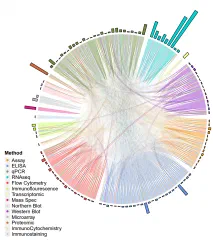
TLDR we included 240 articles in the review and aggregated information from 122 of these into a Meta-analysis by Information Content. MAIC is novel method of quantitatively assessing heterogeneous and non-standardised literature results such as the literature on the ageing macrophage which encompassed 2 mouse strains, 1 rat strain, humans, 4 subtypes of macrophage, and a diverse range of young vs old age classifications and experimental methodologies like qPCR, flow cytometry and ELISA. We quantitatively summarised the top explored genes and proteins in the literature by MAIC as downregulated or upregulated by counting the number of articles that reported upregulation or downregulation with age but weighting by various statistical factors such as degree of sharing across different methodologies in different publications (higher for representation across diverse methodologies). Chord diagrams were used to represent the MAIC data where segments depicted genes (Figure 1)
Markers of the Ageing Macrophage: A Systematic Review and Meta-Analysis

My 4th year integrated Masters project at the University of Sheffield was extended into a systematic meta-narrative literature review of age-related changes in macrophages which was published in Frontiers in Immunology.

TLDR we included 240 articles in the review and aggregated information from 122 of these into a Meta-analysis by Information Content. MAIC is novel method of quantitatively assessing heterogeneous and non-standardised literature results such as the literature on the ageing macrophage which encompassed 2 mouse strains, 1 rat strain, humans, 4 subtypes of macrophage, and a diverse range of young vs old age classifications and experimental methodologies like qPCR, flow cytometry and ELISA. We quantitatively summarised the top explored genes and proteins in the literature by MAIC as downregulated or upregulated by counting the number of articles that reported upregulation or downregulation with age but weighting by various statistical factors such as degree of sharing across different methodologies in different publications (higher for representation across diverse methodologies). Chord diagrams were used to represent the MAIC data where segments depicted genes (Figure 1)

0%