Attending ICML 2026
I will be attending ICML 2026 this year in Seoul Korea where I will be presenting my new paper ‘Spectral Volume Diffusion for Protein Dynamics’ at the GenBio Workshop.
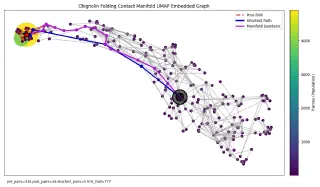
Protein folding is still a difficult problem. Although AlphaFold made great strides in advancing static structure prediction, the dynamic process that transports a protein from random coil to equilibrium structure is difficult to model. Go based Ising-like energy models such as the WSME model were among the first successful mathematical models of protein folding as a kinetic process. The approach is as follows: given a native-like folded conformation, we can assign residues with any possible alternative conformation as either native-like or not. One way to define this is to consider the residue’s formation of native-like contacts ($C_\alpha - C_\alpha$ distance $<8\dot{A}$). In folding this could be the difference between a random coil unfolded state where a given residue makes few native-like contacting pairs with spatially proximal residues, versus the folded state where that residue may exist in an alpha helix.
In the world of computational structural biology you might have heard of diffusion models as the current big thing in generative modelling. Diffusion models are great because primarily they look cool when you visualise the denoising process to generate a protein structure (checkout RFdiffusion Colab notebook), but also because they are state of the art at diverse and designable protein backbone structure generation.